
AI ain’t what it used to be
A decade is a lifetime in tech. We’ve seen it evolve from rudimentary chatbots responding to customer service FAQs to powerful systems like ChatGPT, MidJourney and Google’s Gemini that can write copy, derive pictures and provide deep insights in seconds.
But as remarkable as this is, most AI systems today are reactive: They don’t do anything until we ask a question or issue a command.
The next generation is already here, and it’s called Agentic AI. Unlike traditional AI, which is passive and only follows commands, Agentic AI is able to provide recommendations itself and take actions on behalf of humans. Consider it your assistant, not an instrument.
We discuss what Agentic AI is, how it is not the same as existing AI but: does and can work with it; what this might mean positively (and negatively), for society in general and just life outside our insular heads; and finally, what kind of things can we expect to come talking at us from life?
What is Agentic AI?
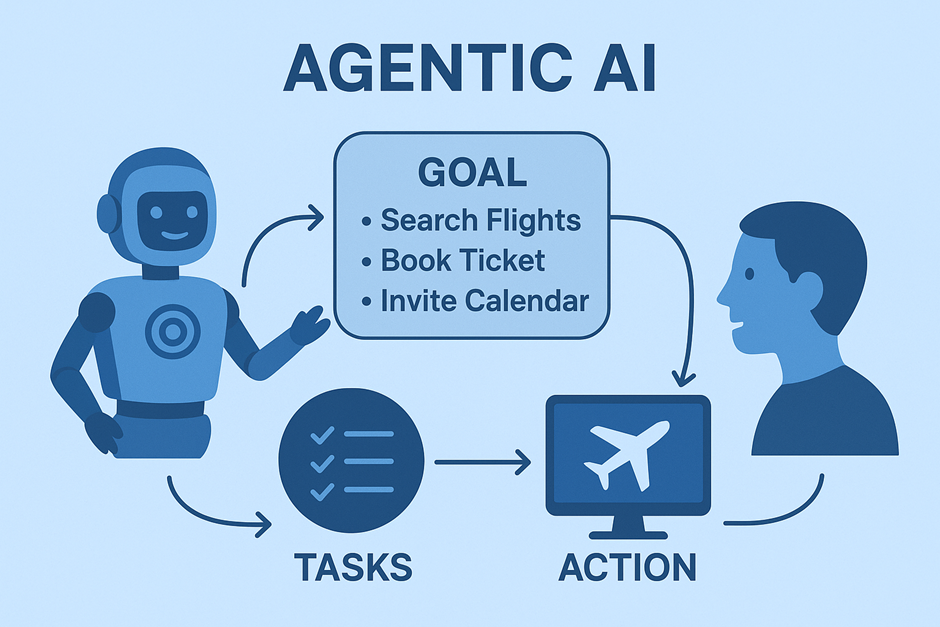
At its heart, Agentic AI is a kind of artificial intelligence with agency; it doesn’t merely react — it acts. It can assimilate goals, subdivide these into tasks, make choices and act to achieve those.
Let’s put it in simple terms:
- Good old-fashioned AI: Your search engine or chatbot. just ask and take response it.
- Agentic AI: As if it were a personal assistant. You describe your ultimate objective, and it figures out how to reach it — sometimes before you even ask for every little detail.
For example:
👉 Ask it (a reactive AI) what the cheapest flight to Delhi is and it will display one.
👉 An Agentic AI will find the flights, compare prices, book the ticket and even send you a calendar invite with all relevant details if you ask it that question.
That’s the difference. It’s not just answering your question — it’s managing the whole workflow.
The Characteristics of an Agentic AI
Agentic AI isn’t merely “smarter” than regular AI; it’s fundamentally dissimilar in its mode of operation. So here are the main elements that differentiate it:
- Autonomy
- It can take initiative when given a goal.
- You needn’t micromanage the pissing ants.
- Goal-Oriented Behavior
- It is not a series of individual action but instead an overall objective.
- Reasoning and Planning
- It doesn’t just do tasks; it thinks about what’s the best way to solve a problematic issue.
- Adaptability
- It is learned and relearned from feedback when something went wrong.
- Multi-Step Execution
- It is able to handle complex workflows, not just individual actions.
That gives Agentic AI more of a feeling that you have a humanistic partner, rather than another digital tool.
Why Does Agentic AI Matter?
Agentic AI is, in fact, a game changer for individuals and businesses. Here’s why:
- Time-Saving
- Free Your Mind We understand that switching between apps and doing repetitive little things is not the right path to big inspiration – so you can stay in the flow with AI at your back.
- Boosted Productivity
- Saving hours a day by automating tasks ranging from scheduling calendar meetings to data analysis, Agentic AI could free up more time for workers.
- Better Personalization
- Its ability to learn and customize your preferences, the way I see it spends more time with it, better for you.
- Reduced Cognitive Load
- All the work doesn’t have to be done by a person any more; the AI does all of the “dirty work.
- Scalability in Businesses
- Agentic AI can perform any of a wide range of tasks in multiple departments – customer service, sales or project management and so on – without regular supervision.
Agentic AI at Work: Applications in the Real World
You could also be asking yourself, “That’s all well and good, but what would it actually look like in my everyday life?”
Here are some practical examples:
- Personal Life
- Planning a trip: You do not need to type flights, hotels and places to visit in while planning a trip as you can simply say “Plan my trip to Goa. Your AI agent will buy tickets, suggest hotels based on pricing that works for you, create a day-by-day itinerary and arrange transportation.
- Workplace Productivity
- You may consider asking your agentic AI: “Please create a sales report for this month, and let’s schedule a meeting on the books with the team. But the A.I. culls information, generates a slick report, sends out calendar invites and even creates the meeting agenda.
- Healthcare
- Patients might even have their own personal AI agents that would, say, control medicines, check health stats from wearable devices and schedule doctor’s appointments — maybe even automatically sharing updates with family members or medics.
- Education
- “Assist me in studying for my history test,” could result in the AI agent pulling up notes, making flash cards and scheduling times to study with various students — then testing those same students until they can nail it.
- Business Operations
- A company could use AI bots to take care of supply chain logistics, delivery tracking and stock re-ordering or dealing with suppliers even without human intervention.
The Challenges of Agentic AI
Now, of course, every great leap also has its downsides.
- Privacy Concerns
- If AI is going to serve us — book a flight, shop for groceries, send email on our behalf — it’s going to want access to that massive amount of personal information. Those raise issues of data safety and misuse.
- Trust and Control
- How much authority should we truly give AI? And if it makes the wrong decision, who will be responsible — you or the A.I.?
- Security Risks
- Once a malicious attacker take control over an AI agent, they can trick it to make illegal transactions or obtain confidential information unofficially.
- Ethical Considerations
- Is there killing and other nasty actions some kinds of AI should be able to do (and not need to ask us first)? For instance, should it be allowed to turn down a meeting for you?
- Dependence on AI
- There is a risk of overdependence on AI for even simple tasks which could diminish human problem solving skills through time.
The Future of Agentic AI
There is a mountain to climb, but the prize at the top looks to be astronomical. We’re undoubtedly heading toward a future in which everyone has personal AI agents, not so different from how we all have smartphones now.
Imagine:
- AI agents managing operations between departments at businesses.
- Teachable pallating: Students tutor AIs which respond differently to their unique learning patterns It’s an AI that learns from the same input patterns as the humans experting it.
- Households where AI takes care of finances, home automation and even shopping.
The opportunities abound but the burden is in building these systems responsibly and safely. To shift AI so it works for us, and not against us, governments, tech companies and developers will need to define far clearer lines.