
There is so much hype today around Technology terms such as (AI), Machine Learning (ML) and Deep Learning (DL). They appear in the news, in job postings and even casual conversations.
But we’re kidding ourselves: Most of us are still confusing them. Some people believe they’re the same thing, others mix up ML and AI, and some even think DL is completely separate.
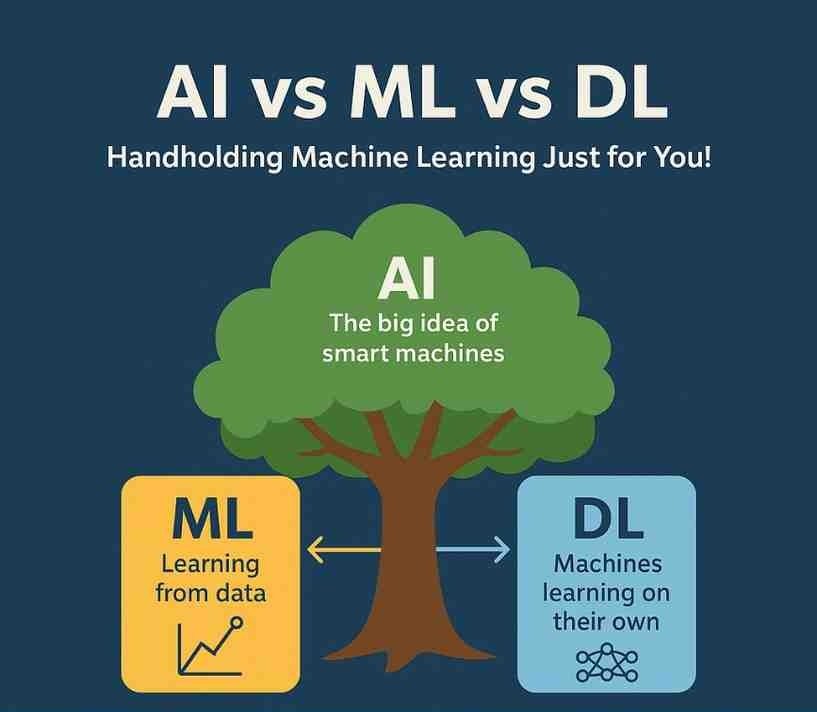
👉 The reality is: AI, ML and DL are related yet different. The simplest way to explain them is with a family tree:
- The parent is AI (the big idea of smart machines).
- ML is the offspring (one way to make machines learn).
- DL is the offspring (most advanced within ML).
In this article we will dissect them into understandable human language with some examples and using comparison table by the end of which, both your life and love spell practices will be clearer for the future.
1. AI as the Big Umbrella
The most encompassed notion is Artificial Intelligence. It is the science of getting computers to act smart like humans.
Consider AI like answering one big question:
“Is it possible to construct a machine that will be capable of thinking, reasoning, and solving problems the way our brains can?”
🔹 Capabilities of AI:
- Science entertains being all about asking questions : Those curious to learn more about things first formulate their specificquestions which they then as convincingly and clearly, comprehensible to every target public (respectively widow’s son), have smartly arranged already including the “what-, who-, wherefrom-, whom- when & why-question” that even “Siri” can answer it any moment now or want allow not alawful response today*)* of course, see 1Co12:9 for how this is possible.
- Pattern recognition (good luck figuring out pirate from porn on your phone’s facial recognization).
- Deciding (as with Google Maps recommending the most efficient route).
- Automating away labour (as in chatbots responding to customer inquiries).
🔹 The state of AI in every day life:
- Your email doing the heavy lifting of sorting promotions and spam.
- Customer service chatbots available 24/7.
- Smart assistants, including Alexa, performing your favorite tunes.
👉 Analogy: AI is to the whole sports world. Every sport is represented — from football to cricket, basketball and more — all under one roof.
2. ML : Learning from Data – Humans using computers to learn.
Machine Learning is a subfield of AI. We do not program machines with rules, instead we let them learn from data and experiences.
For example:
- A spam filter isn’t told exactly how spam looks. Instead, it peeks at thousands of previous emails (data) and learns patterns on its own.
- Netflix recommends what movies to watch by studying your history, not because someone wrote rules that correspond perfectly to your taste.
🔹 How ML works:
- You give the machine data.
- It looks for patterns.
- That’s forecasting based on what you’ve learned.
🔹 Types of ML:
- Supervised learning → Learning from the labeled data I (like teaching a kid using flashcards).
- Unsupervised learning → Discover hidden patterns in data that doesn’t have labels (e.g. sorting similar songs together).
- Reinforcement learning → Learning by trial and error with rewards (think of training your dog to sit).
👉 Analogy: If AI is the entire world of sports, ML is football. It’s just one of thousands of games within AI, each with its own rules and style.
3. Deep Learning (DL) – The Brain-Inspired Tech
Deep learning is a sub set of ML. It uses artificial neural networks, inspired by the way that the human brain processes information.
🔹 Why DL is powerful:
- It does that on a massive scale.
- It doesn’t require humans to spell out which features to look for by hand.
- The accuracy increases as the data scales.
🔹 Examples of DL:
- Cars that can drive themselves will be able to see pedestrians and traffic lights.
- Google Photos sorting photos of a person together.
- ChatGPT generating human-like text responses.
👉 Analogy: If ML is football, DL is a superstar player such as Lionel Messi or Cristiano Ronaldo. It is still football, but it’s all at a much higher, more specialized level.
4. Crucial distinctions among AI, ML, and DL
Here, let’s render this table and make everything crystal clear:
| Aspect | AI (Artificial Intelligence) | ML (Machine Learning) | DL (Deep Learning) |
| Definition | Machines acting smart as humans do | Machine learning from data | Machines learning on their own using brain-like networks |
| Scope | Broadest (AI, ML) | Middle one | Narrower one – most specific of the three. |
| Data requirements | works with rule or small data | needs more data than AI | requires huge amounts of data |
| Human participation | High – rules and logic | Medium – humans define features | Low – learns features automatically |
| Processing power | Low to mid-range | Mid | Very high (needs GPUs/TPUs) |
| Examples | Google Maps, Alexa, chess bots | Spam filters, Netflix recommendations | Self-driving cars, ChatGPT, medical imaging AI |
5. Real-World Applications
Now, let’s see how these three play out in real life.
| Domain | AI Action | ML Action | DL Action |
| Healthcare | AI chatbots for patient support | Predicting disease risk based on health records | Detecting tumors in MRI scans |
| Business | Automated customer support | Fraud detection in transactions | Virtual assistant voice recognition |
| Education | AI education tutor that learns your needs and helps you practice better | Personal-content adaptive learning engine | Automated essay grading, adaptive tests |
| Entertainment | Recommending songs/movies | Personalized recommendations on Netflix/Spotify | Deepfake videos, lifelike animations |
| Car | Parking assist system | Maintenance readiness | Driving-less fully automated car |
6. Why Does This Matter?
Now you may be saying, ”Alright that’s cool and all, but so what-do I care?”
Here’s why:
- For students/job hunters → It’s a standard interview question.
- For businesses → It supports you in determining what technology solves your problem.
- For the common user → It demystifies and makes tech more approachable.
Example:
- If you’re running a small shop → you may deploy ML tools to predict what customers might buy.
- If you are in healthcare → DL models can be used to assist doctors in reading scans faster.
- When you’re creating an app → AI chatbots help save costs on customer service.
7. The Pitfalls of AI, ML and DL
Sure, it’s not all sunshine. These technologies come with challenges.
| Challenge | AI | ML | DL |
| Data | May not require large data | Requires structured data | Requires humongous, high-quality amounts of data |
| Bias | Can have programmer bias added | Chance of amplifying bias | — |
| Price | $ Moderate | $$ Higher (requires storage, training) | $$$ Very high (heavy duty hardware needed) |
| Transparency | Rules are explicit | Models get difficult to explain | Neural networks are “black boxes” |
8. The Future of AI, ML, and DL
The future is bright — and a little frightening.
- AI will be our daily helper, in every gadget.
- ML will make businesses smarter because they are predicting and knowing what the customer want before customers themselves do not know.
- DL will push the envelope in application areas such as medicine, self-driving cars, and even space.
👉 The distinction between AI, ML and DL will become increasingly blurry. The point is how responsible we are with them.
Final Wrap-Up
Here’s the easiest way to remember:
- AI = The grand dream of building intelligent machines.
- ML = How machines learn patterns from data, in practice.
- DL = The cutting-edge brain-derived system behind the hottest technology of today.
So the next time someone presses you on this, you know what to tell them:
“AI is the field, ML is a technique within AI, and DL is an advanced form of ML.”