
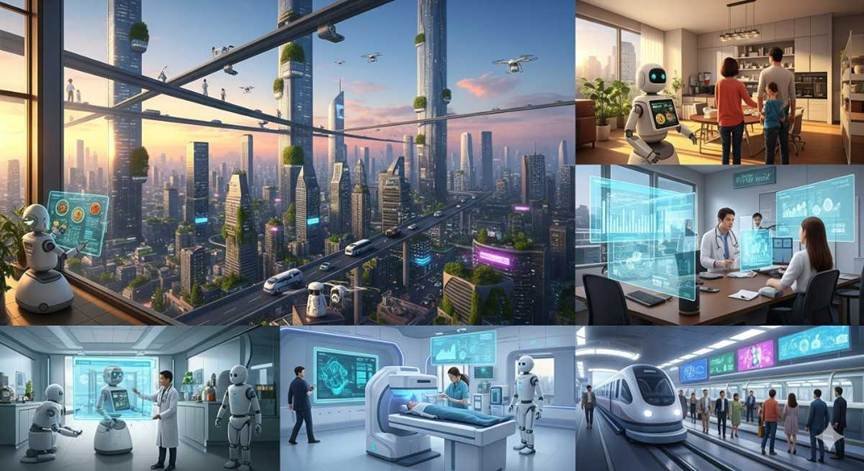
AI is NOT “futuristic” and it’s not just some stuff you watch on your TV screen, called movies! It’s already here, transforming how we work and shop and travel — all the while playing, however much it might even feel to you at times like play. From asking Alexa to play your favorite jam, to tapping on Google Maps for directions with the least resistance – AI is the invisible homeboy that we come in contact with each day.
But that is only the start. The tired vision of artificial intelligence’s future goes something like this: Eventually, computers — robots even! — are designed to grow smarter than people, in all the strange as-yet-undreamt-of-something-different ways. These are some of the ways in which A.I. will evolve, and influence other parts of our lives.
AI in Our Homes
The way AI is most visible in terms of transforming our daily lives might be at home. Smart homes are not just for the rich or super techie: They’re a reality now, and here to stay.
- Smart Assistants: Those small do-it-all machines we can’t stop and think about — from Amazon’s Alexa, Google Home or an Apple Siri — are getting smarter. They can build shopping lists, switch lights on and off, lock doors and even remind you to take medication.
- Energy Savings: THERMOSTATS WITH AI Technology adapt heating/cooling after the daily routine to provide savings and comfort.
- Appliances: Refrigerators that churn out recipes based on what food you have, washing machines smart enough to use water optimally and robotic vacuums with digital maps of your home are all powered by AI.
Indeed, in a few years, you might find that A.I. works as a virtual household manager who knows what you want and need before even you do.
AI at Work
The workplace is one of the biggest battlefields where A.I. will affect us.
- Automation of Mundane Jobs: Tasks that are monotonous such as Data entry, scheduling or email sorting can be completed by automation tools and people could focus on creative and strategic work.
- Personalised learning: AI-grade tools can reskill or upstay workers with suggestions for personalized courses and projects that help them climb in their career.
- Decision Making: AI can analyse vast amounts of data to help businesses predict market trends, offer better customer service and optimise supply chains.
So, yes, there is concern about A.I. taking jobs away, but the reality is it will also create jobs — particularly for jobs related to A.I. training, maintenance and ethics. The future office may be less cubicle farm and more an alliance of humans and their digital workmates.
AI in Healthcare
One of the sectors in which AI has the most power is healthcare.
- Early Diagnosis: AI is able to spot diseases like cancer and heart conditions earlier than doctors, by looking at images of scans, as well as other medical history.
- Customized Treatments: Instead of one-size-fits-all prescriptions, AI can be used to develop customized treatments based on an individual’s genetics, lifestyle and health record.
- Virtual Health Assistants: Think a friendly chatbot reminding you to take your meds, monitoring your symptoms or even making a doctor’s appointment for you.
AI may someday prove itself an able health buddy, keeping tabs on your well-being from wearables and notifying doctors before things get dire.
AI in Education
AI is remaking what and how students learn, and the way teachers teach.
- Personalized Learning: AI based programs can identify your strong and weak points and can make a learning path just for you.
- 24/7 Tutoring: Homework help offers virtual AI tutors to give each student one on one support after school and on weekends for homework problems, questions tutorials videos explaining concepts if stuck!
- Freeing Up Teachers: Automatizing grading, attendance-taking and lesson planning would free up teachers for real teaching.
As AI advances, classrooms might become highly personalized learning environments that do not leave a single child behind in the development of their literacy skills.
AI in Travel and Transportation
How we travel is already being reshaped by A.I.
- Navigation: Apps like Google Maps and Waze rely on A.I. to suggest faster paths around gridlock.
- Public Transport: Bus and train timetables are improved by AI systems that minimize delays, save fuel.
- Self-Driving Cars: Firms like Tesla and Waymo have been working on self-driving cars that use artificial intelligence, a breakthrough development that could alter how we get around.
One day, travel could be safer, faster and even stress-free — with traffic jams, crashes and maybe even vehicle breakdowns a job for the AI.
AI in Shopping and Entertainment
Every day, we encounter AI when we shop or see entertainment.
- Personalized Recommendations: The AI that Netflix uses to recommend what you should watch next, the way Amazon suggests things for you.
- Virtual Try-Ons: AI can let you try on clothes, glasses and even furniture before buying in app.
- Content creation: Music, art and even movie scripts, can all be written with the help of AI.
It could also usher in super-personalized shopping and entertainment experiences: You could have a digital twin that better knows what you like than you do.
A.I.’s Troubles in the Real World
As great as deep learning looks, there are also some issues to address.
- Privacy: If artificial intelligence is watching our habits, concerns about how the data on us will be stored and used.
- Bias: If A.I. learns from biased data, it can yield unfair decisions — such as in hiring or lending.
- Overdependence: When we rely too heavily on AI, human decision-making will atrophy.
Responsible development and regulation will be necessary to ensure that AI is equally beneficial for everyone.
The Future Vision
Imagine your day one morning with this robotic-voiced assistant that informs you of the state of repair of your trusty body vessel when you wake up, zips up 品 breakfast and hails a cab on its way to an office meeting — then leads you through an exercise in mastering a new evening skill.
This is science fiction no more — this is a close-up of the not-too-distant future. “We won’t have just a tool that every now and then we use — it’s going to be a partner on the team, helping us make better decisions and giving us our lives back,” said Mr. Terzioglu.
Conclusion
Whats Rotating Your Future in the Daily Look? It promises a world in which household chores are accomplished more efficiently, health care is smarter, education tailored to individual needs and entertainment viscerally immersive. But it also warns to handle privacy, security and ethics with care.
One thing that is certain is that AI will not replace takanaka and his neighbor but it does alter how we live, work and think. And it’s all about being used in a responsible way, and ensuring that mankind understands how to use it to its maximum benefit.